
Folks, we’ve made it to the case some say is the first Supreme Court case that matters.
While I disagree that it’s the first important case, I get the point. This case is a big deal. We’ll finally get an answer to the major question the Court has long been flirting with — Can a State be sued by a citizen of another State in federal court?
The Court’s answer was so intolerable to the States that they rallied to get a constitutional amendment passed to undo the Court’s decision.
This is a case in the field of constitutional law filed directly in the Supreme Court.
Petitioner: Alexander Chisholm, the executor of South Carolinian merchant Robert Farquhar’s estate.
Respondent: The State of Georgia, which arranged to buy military supplies from Farquhar and — you guessed it — didn’t pay him.
This case was decided by the Jay Court during the Washington Presidency.
Ultimately, the Court ruled in favor of Chisholm, affirming that the People had a right to sue States in federal court. That’s a big deal.
But the States couldn’t stomach the decision. The Eleventh Amendment was proposed less than a year after the Chisholm decision, and it was ratified in 1795, reversing the Court’s 4-1 decision.
See the Court’s meaty opinion here.
It’s like this.
In 1777, during the Revolutionary War, Georgia’s troops needed supplies, badly.1 So the State purchased things like clothing and blankets from South Carolinian merchant Robert Farquhar.2 Farquhar provided the stuff, but Georgia never paid him.3
We’re talking about $169,000 in 1777 money, or approximately $6 mil today.4
In 1784, Farquhar suffered an unfortunate death after he was struck by a sail, “knocked overboard and drowned…”5 That’s terrible luck. (Somebody missed a class at boating school!)
As a result, Farquhar died having never been compensated by the State of Georgia for the war supplies he sold.6
Everything Was Going Fine Until I Was Hit In The Head With A Sail…
Farquhar died with a will. A will is a document a person creates during their lifetime to specify what should happen to their belongings after they die.
Farquhar’s will named Charleston merchant Alexander Chisholm as one of three executors.7 This means that Chisholm was one of the people responsible for ensuring that the will was carried out, or executed, as written.
Farquhar’s ten-year-old daughter, Elizabeth Farquhar, was the beneficiary of his will.8 This means that young Elizabeth was the person who Farquhar picked to receive all of his assets, including his property and money.
So, Chisholm was obligated to do everything he could to ensure Elizabeth received everything her father had. That also meant he had a duty to chase down the debt Georgia owed Farquhar for those war supplies.
The executors asked Georgia’s legislature for payment, but it refused, telling the executors they could instead go after the specific government officials who were responsible for paying Farquhar.9
That was no help. One of the commissioners responsible was dead, and the other probably couldn’t afford to pay what was owed.10
Thanks, Georgia.
So Chisholm sued the State of Georgia in Georgia’s Circuit Court.11
The Governor of Georgia, Edward Telfair, responded to the lawsuit defiantly, declaring that Georgia was “a free, sovereign and independent State,” and that “Georgia cannot be drawn or compelled . . . to answer, against the will of the said State of Georgia, before any Justices of the federal Circuit Court for the District of Georgia or before any Justices of any Court of Law or Equity whatsoever…”12
In other words, Telfair insisted a citizen couldn’t drag a State into federal court. If you remember, the governor of New York said the same thing in Oswald v. New York I-II.
One of the judges hearing Chisholm’s case was Supreme Court Justice Iredell, who was posted in Georgia as part of his circuit-riding duties.13
Justice Iredell ruled against Chisholm because he believed Chisholm was required to sue in the Supreme Court, not in Circuit Court.14
The Constitution says, “In all Cases…in which a State shall be Party, the supreme Court shall have original Jurisdiction.”15
The key word there is shall. Justice Iredell observed that the Supreme Court had dibs on cases where a State was a party. Therefore, the Circuit Court wasn’t able to hear the case, and Chisholm’s lawsuit was dismissed.
So, Chisholm brought his fight to the Supreme Court.
The Arguments
Chisholm served both Governor Telfair and Georgia’s Attorney General, but they refused to show up.16 (Same as New York and its officials in the Oswald cases…)
So Chisholm’s attorney, United States Attorney General Edmund Randolph, asked the Court to enter default judgment against Georgia.17 You’ll remember we saw the same move in Oswald III.
The Court gave Georgia more time to answer, but it still refused to show.18
After giving the Georgians ample opportunity to appear and put up a defense, the Court decided it had to rule on the underlying issue:
Can a citizen of one State sue another State in federal court?
Chisholm argued:
- The Constitution is crystal clear. It says the Court can hear cases between a State and citizens of another State.19 (that’s Article III, Section II).
- It’s crazy to argue a citizen can’t sue a State, because the Constitution itself lists a bunch of stuff States aren’t allowed to do. If citizens aren’t allowed to sue a State, then there’s no remedy for when States violate the Constitution, and that would mean the Constitution is powerless.20
Georgia didn’t provide any arguments because it refused to show up to court.21
The Justices ruled 4-1 in favor of Chisholm. They each wrote an opinion.
The Opinions
Majority Opinions:
Justice Blair
Justice Blair comes out like he’s John Wayne, wielding a six-shooter, riding a horse.
“The constitution of the United States is the only fountain from which I shall draw; and the only authority to which I shall appeal.”22
He declares he isn’t going to consider how they do things in Europe.23 He’s definitely throwing some shade at Justice Iredell, who in his dissent refers to European precedents extensively.
Love that.
Blair’s reasoning is simple. He points to the Constitution, which says, “The judicial Power shall extend to all Cases, in Law and Equity…between a State and Citizens of another State…”24
He argues that because this is a case between a State (Georgia) and a citizen of another State (Chisholm of South Carolina), the matter is clear.25 The Supreme Court can hear this case.
But what about sovereign immunity, the idea that a State is not allowed to be sued? Is a State immune from lawsuits when they are sued by a citizen of a different state? Justice Blair says no. He reasons that by joining the U.S. of A., States are agreeing to abide by federal law. He writes, “[W]hen a state, by adopting the constitution, has agreed to be amenable to the judicial power of the United States, she has, in that respect, given up her right of sovereignty.”26
Justice Blair concludes that Georgia must appear because it is not immune to lawsuits brought by citizens of other states. If Georgia doesn’t appear, then the Court will enter default against the State.27
Justice Wilson
Justice Wilson begins his opinion with drama. He writes,
“This is a case of uncommon magnitude. One of the parties to it is a State, certainly respectable, claiming to be sovereign. The question to be determined is, whether this state, so respectable, and whose claim soars so high, is amenable to the jurisdiction of the supreme court of the United States? This question, important in itself, will depend on others, more important still; and may, perhaps, be ultimately resolved into one, no less radical than this — ‘do the People of the United States form a Nation?’”28
Justice Wilson looks at the question of sovereign immunity from three angles — (1) general legal principles; (2) laws of other nations; and (3) the Constitution.
General Legal Principles
Justice Wilson argues that Man is “fearfully and wonderfully made” by God, whereas a State is made by Man.29 Therefore, a State is “subordinate to the People.”30 To hold a State as being above Man is “against the natural order of things” and a “perversion.”31
The guy sounds like a Christian minister, right?
Justice Wilson says a State is basically “an artificial person.”32 Therefore, he argues, why shouldn’t a State be held to the same standard as a person?33 He paints the picture of a dishonest State and a dishonest merchant.34 If a merchant violates a contract, he’s in danger of being dragged into court. So, if a State violates a contract, why should it be protected from the same fate?35
Justice Wilson asks, “…upon general principles of right, shall the [dishonest State], when summoned to answer the fair demands of its creditor, be permitted…to assume a new appearance, and to insult him and justice, by declaring I am a sovereign state? Surely not.”36
Perhaps most radically, Justice Wilson reasons that the State of Georgia is not a sovereign State because the power of the State resides in the People.37
“[Republican] government is—one constructed on this principle, that the supreme power resides in the body of the people…[T]he citizens of Georgia, when they acted upon the large scale of the Union, as a part of the ‘People of the United States,’ did not surrender the supreme or sovereign power to that state; but, as to the purposes of the Union, retained it to themselves. As to the purposes of the Union, therefore, Georgia is not a sovereign state...the allegation that Georgia is a sovereign state, is unsupported by the fact.”38
Laws of Nations
Justice Wilson concedes that, in England, “no suit can be brought against the King, even in civil matters.”39
He also points out, however, that when the Saxons ruled England, even the King and Queen could be sued.40 He cites to King Frederick of Prussia, who said, “Judges ought to know, that the poorest peasant is a man, as well as the king himself: all men ought to obtain justice, since, in the estimation of justice, all men are equal, whether the prince complain of a peasant, or a peasant complain of the prince.”41
Under the Constitution
Justice Wilson complains that there’s been a lot of ink spilled about kings and States, but little about the People.42 He reminds the reader,
“The people of the United States intended to form themselves into a nation, for national purposes. They instituted, for such purposes, a national government, complete in all its parts, with powers legislative, executive and judiciary; and in all those powers, extending over the whole nation. Is it congruous, that, with regard to such purposes, any man or body of men, any person, natural or artificial, should be permitted to claim successfully, an entire exemption from the jurisdiction of the national government? Would not such claims, crowned with success be repugnant to our very existence as a nation?43
Justice Wilson concludes by saying the question isn’t difficult. He says he reaches his conclusion not through deduction from the Constitution, but by the clear declaration of the Constitution.44 By the Constitution’s own language, the Court is empowered to hear cases between a State and a citizen of another State.45
Justice Cushing
Justice Cushing says this case “seems clearly to fall within the letter of the constitution.”46 In fairness to Georgia, he tests the theory that maybe the Constitution allows for a State to sue in federal court, but not be sued in federal court. Maybe the Constitution didn’t intend for States to be sued in federal court.
The theory fails.
The Constitution says that the Court can hear cases between States.47 So that theory falls on its face. If there’s any doubt as to whether a State can be a defendant or respondent in a case, the Constitution resolves it.48
Justice Cushing also raises a moral point – why can the State of Georgia bring a suit in the Supreme Court against a citizen of another State (as it did in Georgia v. Brailsford), but be spared from suits in the opposite direction?49
He declares, “The rights of individuals and the justice due to them, are as dear and precious as those of states,” and “the great end and object of [States] must be[] to secure and support the rights of individuals, or else, vain is government.”50
A final note on Justice Cushing’s opinion. He writes, “If the constitution is found inconvenient in practice…it is well that a regular mode is pointed out for amendment. But while it remains, all officers, legislative, executive and judicial, both of the states and of the Union, are bound by oath to support it.”51
These two sentences would prove an omen for what was to come.
Chief Justice Jay
After thin opinion after thin opinion, Chief Justice Jay finally speaks up, writing an opinion that clocks in at 10 pages.
He begins by reminding us that it was the People who “established the present constitution…acting as sovereigns of the whole country.”52
He then goes on to dismiss comparisons to the European way of addressing sovereign immunity because the United States government is structured very differently.53 He distinguishes the sort of absolute and sweeping powers afforded to European royals with the more restricted powers of the governments and officials of the States.54
Chief Justice Jay makes an interesting mathematical argument, too, arguing that when one State sues another, that’s the same thing as all of the people in one State suing all of the people of the other.55 Therefore, he argues, one citizen of one State should be allowed sue all of the citizens of another State.56
He also points out the hypocrisy of Georgia suing in the Supreme Court, but running away when it finds itself sued in the same forum. He writes, “The citizens of Georgia are content with a right of suing citizens of other states; but are not content that citizens of other states should have a right to sue them.”57
Chief Justice Jay also agrees the Constitution’s language is clear on the sovereign immunity issue, writing, “If we attend to the words, we find them to be express, positive, free from ambiguity, and without room for such implied expressions: ‘The judicial power of the United States shall extend to controversies between a state and citizens of another state.’”58
Rather than just citing to the language, the Chief Justice offers some explanation as to why the Constitution says this. It’s a fairness thing. It’s not fair for a State’s own court to have the final say in a dispute between that State and another State’s citizen.59
Chief Justice Jay is emphatic in his argument that the Court is reaching a fair result here.
“The exception contended for [by Georgia and the dissent], would contradict and do violence to the great and leading principles of a free and equal national government, one of the great objects of which is, to ensure justice to all: to the few against the many, as well as- to the many against the few. It would be strange, indeed, that the joint and equal sovereigns of this country, should, in the very constitution by which they professed to establish justice, so far deviate from the plain path of equality and impartiality, as to give to the collective citizens of one state, a right of suing individual citizens of another state, and yet deny to those citizens a right of suing them.”60
Resolute as Chief Justice Jay is in his opinion, he does have reservations about one piece of it. That is, the Constitution appears to provide “that the United States may be sued by any citizen…”61 Chief Justice Jay circumvents this uncomfortable resting place for his argument by gently explaining why a case that’s “Citizen versus State” is different from a case that’s “Citizen versus United States.” He limply concludes, “I leave it a question.”62
(Indeed, the Court will address the issue of whether a citizen can sue the U.S. in later cases. For now, we stick with Chisholm.)
The State of Georgia was subsequently ordered to appear.63 Otherwise, it would find itself in default.64
Dissenting Opinion:
Justice Iredell
Justice Iredell begins his dissenting opinion with a confession. Remember Van Staphorst v. Maryland, the tobacco case? Well, upon reflecting on that case at the top of his dissent in Chisholm, Justice Iredell writes, “I had then great doubts upon my mind, and should, on such a case, have proposed a discussion of the subject [of sovereign immunity].”65
He continues, “Those doubts have increased since, and after the fullest consideration I have been able to bestow on the subject, and the most respectful attention to the able argument of the attorney-general, I am now decidedly of opinion, that no such action as this before the court can legally be maintained.”66
Why does Justice Iredell conclude he can’t support a citizen suing another State?
First, he argues that Congress hasn’t authorized the Court to hear this sort of case. Specifically, he writes, “[T]he constitution, so far as it respects the judicial authority, can only be carried into effect, by acts of the legislature, appointing courts, and prescribing their methods of proceeding.”67
For Justice Iredell, it’s not enough that the Constitution outlines that the Court can hear these kinds of cases.68 Congress also needs to pass a law authorizing the Judicial Branch to act.69
I guess it’s kind of like saying, “Just because you have a bike in the garage doesn’t mean you can ride it. Mom (Congress) needs to give you permission to take it out.”
Justice Iredell believes Court cannot act here because it would be circumventing Congress, because Congress hasn’t passed a law that provides for an adequate remedy for this kind of dispute.70 He believes this even though the Constitution has the language specifying that the Court can hear these kinds of cases.
The Court has the gun. Congress needs to supply the bullet.
He writes, “…[A]n article of the constitution cannot be effectuated without the intervention of the legislative authority.”71
Justice Iredell then contemplates whether Congress has provided a law empowering the Court to hear such cases…and he observes they have not.72 He even reaches back to common law looking for the green light, and the common law is no help.73
Therefore, he reasons, “[T]he suit in question cannot be maintained…”74
Justice Iredell is comfortable deferring to Congress because, in his view, the structure of the Constitution is such that it is “calculated to guard against that innovating spirit of courts of justice…”75 He’s taking a very conservative view of judicial power.
In sum, Justice Iredell acknowledges the States must answer to the federal judiciary…but there’s got to be a law giving the Court authority here.76
The Decision
So the Court ruled 4-1 in favor of Chisholm, meaning the Court definitively ruled a State can be sued by a citizen of another State. A great win for the People, right?
Well, the victory was short-lived. In a stunning act of oppression, Congress tripped over their feet sprinting to propose a constitutional amendment to change the Constitution so a State couldn’t be sued in federal court by a non-citizen. Congress introduced an amendment the same damn day as the Court released its opinion.77
Remember, it isn’t easy to revise the Constitution. A constitutional amendment, or a change to the Constitution, needs to be accepted, or ratified, by 3/4 of the States in order for it to go into effect.78
The reaction to Chisholm in Georgia was particularly inflamed. Georgia’s House of Representatives proposed that anyone who dared to try to collect judgment against the State “shall be…declared to be guilty of felony, and shall suffer death, without the benefit of clergy, by being hanged.”79
That’s…a strong reaction.
The resolution for death by hanging without a priest died in Georgia’s Senate, but the fact that it even got that far shows how outraged the Georgians were.80
Congress, on the other hand, succeeded in getting the amendment to stick.
The Eleventh Amendment was ratified in 1795. It reads, “The Judicial power of the United States shall not be construed to extend to any suit in law or equity, commenced or prosecuted against one of the United States by Citizens of another State, or by Citizens or Subjects of any Foreign State.”81
Chisholm, then, was overturned, or invalidated.
Why The Hard Feelings?
Why such a harsh reaction by the States? Well, the States feared being bled dry financially. If they had to deal with an onslaught of lawsuits from private citizens of different States, State governments could potentially be overwhelmed and “treasury funds…drained.”82
I get it. The States thought, probably honestly thought, they’d be immune from lawsuits in federal court brought by citizens of other States. While I can’t draw a direct line from The Federalist to the States’ assumption they were immune from these kinds of lawsuits, I think it’s worth noting that Alexander Hamilton, before the Constitution was accepted by all of the States, assured the States they wouldn’t be subjected to these kinds of suits.
Remember, Hamilton, James Madison, and John Jay wrote essays for The Federalist to persuade the States to ratify the Constitution.
In his Federalist No. 81, Hamilton wrote,
…It is inherent in the nature of sovereignty not to be amenable to the suit of an individual WITHOUT ITS CONSENT. This is the general sense, and the general practice of mankind; and the exemption [of sovereign immunity], as one of the attributes of sovereignty, is now enjoyed by the government of every State in the Union…[I]t will remain with the States, and the danger intimated must be merely ideal.”83
Evidently, some took Hamilton at his word even though the Constitution says the complete opposite.
A Note on Chisholm…
What happened to Chisholm? Did he ever get paid? Well, in 1794, Georgia agreed to settle the case, but in reality, Georgia didn’t actually pay Farquhar’s estate until 1847 .84 That’s not a typo. It took Georgia 53 years to pay Farquhar’s estate.
These are the guys who are entitled to sovereign immunity? Give me a break…
Why I’m Fired Up
This case tells the story of how the Supreme Court stood for the People, only for Congress and the States to turn the gun on their constituents and take away a right enshrined in the Constitution.
The Constitution clearly and expressly states that States can be sued by citizens of different States. That’s it. The majority properly recognized that. Even Justice Iredell concedes that fact in his dissent, only he argues the Constitution isn’t enough. Yeah, okay. According to Iredell, the founding legal document of the United States of America, the very thing that empowers the three branches of government to operate, isn’t enough to empower the federal courts to hear cases that the Constitution clearly empowers them to hear.
Sure.
I understand his concern about “guard[ing] against that innovating spirit of courts of justice.” But where is the innovation here? The Justices in the Majority simply read the Constitution as it was written.
If judges can look to a crystal clear provision of the Constitution and say, “Nah, I don’t think so,” we’re in trouble.
Now, I do understand the States’ perspective. I appreciate how new the nation was at the time of the decision, and how important it was that the States not feel the federal boot on their necks so early on. I get that the States at the time were struggling to pay their debts as is.
But I think the government — Congress and the State governments alike — could have been more measured in their response to the Court’s decision.
I don’t know, maybe allow for sovereign immunity to extend to the States as a courtesy for a limited period of time, like a decade or so, so the States could get their financial footing?
Maybe Congress could have enacted strict procedural laws to make it more challenging for citizens to sue States. Maybe enact a statute of limitations.
Couldn’t they have done something to at least preserve the illusion of accountability?
Look, is a State in jeopardy of being wiped of its riches by trigger-happy litigants? Perhaps. If so, then State governments have an even greater obligation to be frugal stewards of the purse. Maybe the States should pay their debts. Maybe the States should be accountable to average citizens who they screw in business transactions.
All of the People risk liability for wrongdoing. Why not, then, the States, which are merely collections of people?
Okay, who else is on my hit-list? Have I mentioned I don’t like Hamilton? In case I haven’t, I don’t like Hamilton.
Shame on Congress, shame on the States, shame on Hamilton…who else?
Shame on the State of Georgia specifically. These hypocrites are quick to sue a guy to recover slave debt (see Georgia v. Brailsford), but when their asses get sued for failing to pay a guy who they practically robbed, suddenly they can’t be dragged into Court? Georgia’s my least favorite State in the Union right now. We’ll see how that opinion evolves as we read more cases…
In sum, I think Chisholm v. Georgia, for the short time it was good law, was revolutionary on paper. The Court’s decision is a strong declaration that the American way is far, far different than the way of the monarchs the Americans broke free from. The decision fits seamlessly with the canon of great American writings, and it is woven beautifully into the elaborate tapestry of the United States’ freedom-loving character.
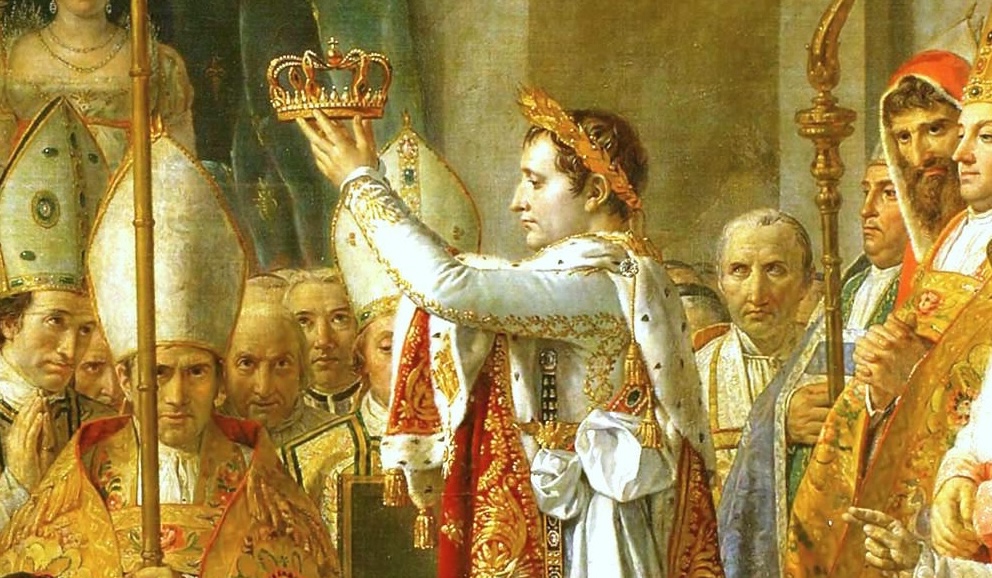
And yet, Congress snapped us back to a royal rule designed to protect kings, in a nation where we aren’t supposed to have royals. The Eleventh Amendment, I think, takes the States and crowns them little kings. More precisely, it seems to me the States crowned themselves.

Here, Napoleon crowns himself the sovereign…
I’ll wrap with a quote from political philosopher Edmund Burke, who said in 1775,
“In this character of the Americans, a love of freedom is the predominating feature which marks and distinguishes the whole: and as an ardent is always a jealous affection, your colonies become suspicious, restive, and untractable, whenever they see the least attempt to wrest from them by force, or shuffle from them by chicane, what they think the only advantage worth living for. This fierce spirit of liberty is stronger in the English colonies probably than in any other people of the earth…”85
I need to know what you think of this case.
You Be The Judge
Have more to say? Leave a comment!
Studying this case for class? I offer 1-on-1, virtual law school tutoring. Learn more here.
Here’s a Bluebook cite for ya – Johnathan J. Azar, A Decision So Radical, The States Rewrote the Constitution: Chisholm v. Georgia (1793) (April 9, 2026)
FOOTNOTES
- Doyle Mathis, Chisholm v. Georgia: Background and Settlement, 54 J. Am. Hist. 20 (1967). ↩︎
- Id. ↩︎
- Id. at 21 ↩︎
- MeasuringWorth, Relative Value of the U.S. Dollar, https://www.measuringworth.com/calculators/uscompare/relativevalue.php. ↩︎
- Mathis, supra, at 21. ↩︎
- Id. ↩︎
- Id. ↩︎
- Id. ↩︎
- Id. at 22 ↩︎
- Id. ↩︎
- Id. ↩︎
- Id. ↩︎
- Id. at 23 ↩︎
- The Supreme Court Decides in Chisholm v. Georgia, Independence Nat’l Historical Park (Nat’l Park Serv.), https://www.nps.gov/articles/000/chisholm-v-georgia.htm ↩︎
- U.S. Const. art. III, § 2, cl. 2. (emphasis added) ↩︎
- Chisholm v. Georgia, 2 U.S. (2 Dall.) 419, 419 (1793). ↩︎
- Id. ↩︎
- Id. ↩︎
- Id. at 419-420 ↩︎
- Id. at 420-421 ↩︎
- Id. at 419 ↩︎
- Id. at 449 ↩︎
- Id. ↩︎
- U.S. Const. art. III, § 2. ↩︎
- Chisholm v. Georgia, 2 U.S. (2 Dall.) 419, 450 (1793). ↩︎
- Id. at 452 ↩︎
- Id. ↩︎
- Id. at 453 ↩︎
- Id. at 454 ↩︎
- Id. ↩︎
- Id. ↩︎
- Id. at 455 ↩︎
- Id. at 456 ↩︎
- Id. ↩︎
- Id. ↩︎
- Id. ↩︎
- Id. at 457 ↩︎
- Id. (emphasis added) ↩︎
- Id. at 459 ↩︎
- Id. ↩︎
- Id. at 460 ↩︎
- Id. at 461 ↩︎
- Id. at 465 ↩︎
- Id. ↩︎
- Id. at 465-466 ↩︎
- Id. at 467 ↩︎
- Id. ↩︎
- Id. ↩︎
- Id. at 468 ↩︎
- Id. ↩︎
- Id. ↩︎
- Id. at 470-471 ↩︎
- Id. at 472 ↩︎
- Id. ↩︎
- Id. at 473 ↩︎
- Id. ↩︎
- Id. ↩︎
- Id. at 476 ↩︎
- Chisholm v. Georgia, 2 U.S. (2 Dall.) 419, 475 (1793). ↩︎
- Id. at 477 ↩︎
- Id. at 478 (emphasis added) ↩︎
- Id. ↩︎
- Id. ↩︎
- Id. ↩︎
- Id. at 429-430 ↩︎
- Id. at 430 (emphasis added) ↩︎
- Id. at 449 ↩︎
- Id. ↩︎
- Id. ↩︎
- Id. at 433 ↩︎
- Id. ↩︎
- Id. ↩︎
- Id. ↩︎
- Id. ↩︎
- Id. ↩︎
- Id. at 436 ↩︎
- Mathis, supra, at 25-26 ↩︎
- U.S. Const. art. V. ↩︎
- Federal Judicial Center, Chisholm v. Georgia, in Cases That Shaped the Federal Courts 10 (2020). ↩︎
- Id. ↩︎
- U.S. Const. amend. XI. ↩︎
- Federal Judicial Center, supra, at 8 ↩︎
- The Federalist No. 81 (Alexander Hamilton) ↩︎
- Mathis, supra, at 27, 29 ↩︎
- Edmund Burke, Speech on Conciliation with the Colonies (Mar. 22, 1775), reprinted in The Founders’ Constitution vol. 1, ch. 1, doc. 2 (Philip B. Kurland & Ralph Lerner eds., 1987), https://press-pubs.uchicago.edu/founders/documents/v1ch1s2.html. ↩︎

Disclaimer: All content on Lex Sans Latin is provided for educational and informational purposes only, and does not constitute legal advice. Nothing on this site creates an attorney–client relationship. If you need legal advice, please consult an attorney.
This blog may include quotations or excerpts from judicial opinions, statutes, scholarly articles, books, and other primary or secondary sources. Such materials are used for purposes of commentary, criticism, teaching, scholarship, and research in accordance with the fair use doctrine under U.S. copyright law (17 U.S.C. § 107). All cited materials are attributed to their original sources to the extent reasonably possible.
Any tutoring or instructional services offered are educational in nature and are not a substitute for legal advice or legal representation.





Leave a Reply