
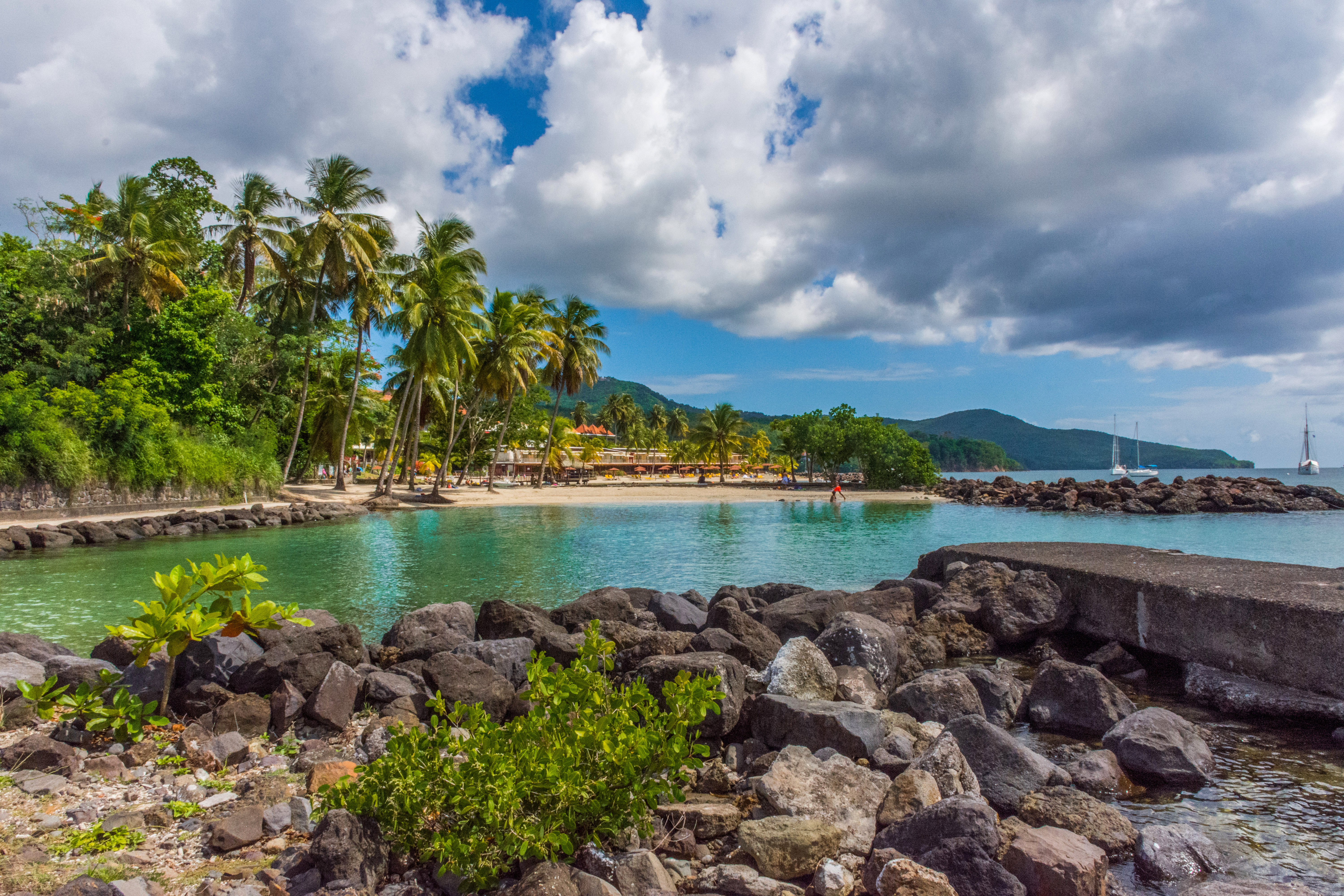
Martinique in 1776. To the globe, France’s sugar jar, a tropical hub of production supplying massive quantities of the white stuff to France, straight to the patisserie. Martinique was a place renowned for its mammoth sugar industry, an industry vitalized by Jews following their expulsion from Brazil, and which thrived long after their eventual expulsion from Martinique.1
The Jews also introduced cacao to Martinique, so the French were able to make chocolate, too.2
Industry necessitates labor, so then came the slaves.3
In 1776, this is what Martinique was to the globe — a Wonka’s Wonderland in the hands of the French, from the pocketbooks of the Jews, built on the backs of the Africans.
What the world didn’t know about Martinique was, at the same time it was being used for France’s confectionary operation, the American Revolutionaries were covertly using the island to exchange American tobacco for French guns, money, and war supplies.4
Indeed, Martinique had quietly become a critical hub for American intelligence and military operations.5
The French, eager to support the yankees against the Brits, but intent on keeping their support quiet, allowed the Americans to conduct their business in the Caribbean, on one of their islands.6
The American man in charge of this audacious undertaking? William Bingham, a secret agent sent to Martinique by the U.S’s Committee of Secret Correspondence.7
You may not know his name — I didn’t until studying this case — but you should. Decades after the Revolution, John Quincy Adams said that “…the [United States] had really been governed by Bingham and his family connections.”8
And when the Revolutionary War eventually ended, Bingham was believed to be the richest man in the United States.9
That’s the man at the heart of Bingham v. Cabot. A spy named Bingham, at Martinique.
This is an evidence case coming out of Massachusetts.
Petitioner: William Bingham, an agent of the United States who got stuck dealing with an international fiasco where an American ship mistakenly captured a neutral vessel.
Respondent(s): The joint-owners of the offending ship, led by John Cabot, a member of Boston’s wealthy Cabot family.
This case went to the Jay Court during the Washington Presidency. The Court ultimately ruled in favor of Bingham, agreeing that the lower court should’ve allowed Bingham to present the evidence he wished to use to make his case.
See the Court’s opinion here.
It’s like this.
After years of supplying the Americans covertly, the French finally, formally declared war against Great Britain in 1778.10 By then, the secret of Martinique was a secret no longer — the French were supporting the Americans, and they were using Martinique to do it.

The Inciting Incident of Bingham v. Cabot.
That same year, an American ship, owned in part by John Cabot, captured a brig called the Hope, suspecting the Hope was a British boat.11
(After studying Glass v. The Sloop Betsey, we know that when one ship captures another, the captured ship is called a prize.)
After taking their prize, the Americans brought the Hope into Martinique.12 There, they discovered they made a serious mistake.
The Hope wasn’t a British ship. It was Danish.13 And the stuff on the boat belonged to the Portuguese.14 So the Americans captured a ship that was totally neutral.15
To make matters worse, the cargo on the Hope was flour…which is perishable.16 This meant the Americans couldn’t just send it back. And the ship was badly damaged, so it needed repairs.17 It seemed, then, that the Hope wasn’t going anywhere. Naturally, then, this became Bingham’s problem.
Because there were no admiralty courts in Martinique for this kind of dispute, Bingham made the executive decision to sell the flour.18 Then, he held onto the proceeds until Congress decided who exactly the money should go to.19 Luckily, flour was a hot commodity on Martinique, so Bingham had no trouble selling it, and for a decent price, too.20
“He Belongs to Intelligence”
In 1784, the American who captured the Hope, William Carlton, sued Bingham for the value of 1,000 barrels of flour in a case called Carlton v. Bingham.21
What an absurd ask. James Bond doesn’t pay.
Remember, Bingham was an agent of the U.S. when he was working in Martinique, sent there by the U.S’s Committee of Secret Correspondence.
Imagine if Bond awoke from a crippling hangover only to find himself forced to handle a diplomatic crisis he didn’t sign up for. Would MI6 let him hang? I don’t think so. (Well, maybe yes if it’s Daniel Craig’s Bond.)
So perhaps we shouldn’t be surprised that Congress sent a letter to the Massachusetts state court advocating for Bingham. Congress wrote that Bingham “only acted in obedience to the commands of the General of Martinique, and in conformity with his duty as agent for the United States…”22
Congress practically begged for Bingham to be relieved of any legal claims on his personal property and, remarkably, insisted it would cover any expenses Bingham might owe as a result of the lawsuit.23
Sounds a lot to me like, “He belongs to intelligence,” the implication being, “He’s ours, don’t touch him…”24
Ultimately, Congress’ letter of recommendation was enough to get Bingham out of trouble. He prevailed in state court, and was vindicated on appeal.25
Viva la Cabot
Although Bingham successfully defeated Carlton, the American “prize-master” who captured the Hope, the other American owners of the offending ship weren’t satisfied. They wanted a piece of Bingham’s pocketbook.
One owner, John Cabot, spearheaded the effort against Bingham in federal court, seeking about $30,000 in back-then U.S. dollars.26 That’s something like $1 million dollars in today’s money.27
John Cabot filed his case in Massachusetts Circuit Court, where Supreme Court Justice Cushing was stationed while riding circuit.28
The case was to go to trial.29
Now get this. John Cabot was a member of Boston’s wealthy, elite Cabot family.30 How elite? The saying goes, “The Cabots talk only to God.”31
Whether or not you’re a Bostonian, you’ve definitely heard of the Cabots. Well…at least one of them.
Remember the Coldplay kiss cam incident that captured the world’s attention, where Chris Martin unwittingly exposed a cheating couple?
Well, the woman who infamously ducked out of frame is Kristin Cabot, a member of the very same Cabot family who brought this case against William Bingham in the 1790s.32
Isn’t that wild?
Let’s Talk Evidence
In order to defend himself against Cabot’s lawsuit, Bingham wanted to introduce four documents into evidence.
Evidence is the stuff you bring to court to support your case. But you can’t just bring anything you want. The judge overseeing a case will decide whether she will allow the evidence to be used.
If evidence is allowed, we say it’s admissible.
If evidence is not allowed, we say it’s inadmissible.
In 1975, Congress passed a set of rules called the Federal Rules of Evidence (FRE), which became the standard evidence rules for civil cases in federal court.33 The FRE is what law students study in Evidence class today.
But back in 1795, the U.S. didn’t have evidence laws written out in a rulebook.34 Instead, rules of evidence came from common law.35
So, what are some things Bingham wanted to introduce into evidence in his trial? The list includes:
- Documents related to the Hope‘s capture.36 Bingham wanted to introduce the records showing what happened on the ground (or in the sea) when the Hope became his problem, and how he went about dealing with the ship and the flour. These documents included his letters to Congress and to the governor of Martinique.
- Court records for the case Bingham won, Carlton v. Bingham.37
- Congress’ letters advocating for Bingham.38 These are the letters Congress wrote to the Massachusetts state court saying Bingham was its agent.
Ultimately, Justice Cushing did not let Bingham introduce any of the evidence.39
Bingham thought the Circuit Court made a mistake. So he filed what’s called a bill of exceptions letting Justice Cushing know he disagreed with his decision to exclude the evidence.40
Well, the Massachusetts Circuit Court jury ruled in favor of Cabot, and they said Bingham had to pay nearly $30,000 in damages.41
Bingham, unwilling to stand for this defeat, asked the Circuit Court for a new trial.42
Justice Cushing said no.43
So Bingham appealed to the Supreme Court.44
The Arguments
The Court took up a few different issues, but we’re going to focus on the arguments pertaining to evidence, as evidence is the issue that tips the scales.
The argument went like this:
Bingham argued:
- The lower court should have let me bring in documents related to the Hope’s capture. These documents, including my letters to Congress letting them know what was happening, show I was acting as an agent of the U.S. government.45
- The record of Carlton v. Bingham should’ve been admitted. The record shows that I wasn’t allowed to just give away the money I raised from selling the flour. My hands were tied until I knew who the money was supposed to go to.46
- The lower court should have let me introduce the letters Congress wrote advocating for me. They show I was acting as an agent of Congress when I sold the flour.47
Cabot argued:
- The lower court properly barred documents related to the Hope’s capture. Bingham’s letters shouldn’t be admissible because they’re his letters. How can we rely on letters Bingham wrote? Such letters are obviously self-serving.48 We can’t take what he wrote as truth.49
- The lower court properly barred court records from the prior lawsuit against Bingham. There’s already a rule on the books about this. A verdict in a trover case like Carlton v. Bingham, which is a common law case where one party seeks money for property someone took unlawfully, can’t be used as evidence in this kind of case.50
- The lower court properly barred the letters Congress wrote advocating for him. The timing is misleading. Congress passed these resolutions after Bingham sold the flour.51 This means Congress didn’t order Bingham to do anything related to the sale of flour.52 So these letters don’t actually show that Bingham was acting as an agent of the United States when he wronged all of us.
The Opinions
The Justices ruled 3-1 in favor of Bingham. Each Justice gave his own opinion.
Justice Paterson
Here we have the first opinion written by Supreme Court Justice William Paterson, who President Washington appointed to the Court after Justice Thomas Johnson resigned.53
Finally, some representation from Jersey!
This guy was legit. Before getting to the Supreme Court, he signed the Constitution and was the governor of the great state of New Jersey.54
People who live in Jersey today know this guy’s name. Both William Paterson University and the City of Paterson are named after him.55
On the evidence, Justice Paterson decides that Bingham’s letters to Congress should have been admitted into evidence. He reasons, “[Bingham’s] contemporaneous correspondence on the subject [of the sale]…with the American government, was, certainly, proper evidence, to show the original nature and complexion of the facts in controversy.”56
Although he doesn’t write about the records from Bingham’s prior lawsuit, Justice Paterson does write about Congress’s resolutions supporting Bingham.
However, he treads a bit more carefully in assessing whether Congress’s resolutions should come into evidence.
This makes sense. The Court was deciding an issue about the power of Congress’s resolutions. Whatever the Court decided could have a major impact on government power.
In order to reach a conclusion, Justice Paterson asks: (1) Did Congress have the authority to pass the resolutions? and (2) Did the resolutions relate to the lawsuit?57 Justice Paterson ultimately reasons that because Congress had the authority to pass the resolutions, and because the resolutions did relate to the lawsuit, they should have been admitted.58
Justice Iredell
Like Justice Paterson, Justice Iredell agrees that “many of the documents offered in evidence have been improperly rejected.”59 In doing so, he gives us a helpful window into how evidence law works.
Justice Iredell notes that the question of whether Bingham was truly an agent of the United States when he sold the flour was a huge question with serious implications for the outcome of the case.60 Therefore, he argues, Bingham’s letters to Congress should have been admitted into evidence.61
Same for Congress’s resolutions. Justice Iredell writes, “The resolutions of [C]ongress likewise were proper evidence—not, indeed, to prove that [Cabot was not] entitled to the money in question, but to prove that [Bingham] was recognized in the transaction as the agent of [C]ongress. The resolutions are not to be considered as the mere expression of a congressional opinion, but as an acknowledgment that Mr. Bingham was a public agent, and that the public, as his principal, was accountable for the money.”62
Justice Iredell’s statement gives us insight into a critical aspect of evidence law.
Sometimes, evidence that can suggest or prove multiple things can only be admitted for a specific purpose.63
This means that evidence law is not only about what piece of evidence a party is trying to introduce to prove his case, but also why a party is trying to introduce that piece of evidence.
Think about it.
Congress’s resolutions could suggest a couple of things. They could suggest Bingham was an agent of the United States. Or, more broadly, they could suggest Bingham didn’t owe Cabot a dime. So the same evidence can suggest two different things.
Here, Justice Iredell says the resolutions should have been admitted for the limited purpose of showing Bingham was an agent of the United States, and for no other purpose.
Over the course of litigation, the judge is the referee who decides what evidence can come in, and for what purpose.
This tension between what is being offered into evidence, and why, is the crux of evidence law. Oftentimes, a party can only admit a piece of evidence to demonstrate one specific fact, to the exclusion of many other facts the same piece of evidence could potentially suggest.
Why do courts so closely police how evidence can be used? Well, to ensure the evidence is being used fairly. We’ll have a lot to say about evidence law as we dive into more cases.
Justice Iredell concludes his opinion by suggesting that the case be sent back to the Circuit Court for a new trial.64
Justice Wilson
Justice Wilson agrees with Justice Paterson and Justice Iredell, but does not believe the Court has the power to order a new trial, so instead, he simply says the lower court’s judgment should be reversed.65
Justice Cushing
Hmm, do we think Justice Cushing, the target Bingham’s appeal to the Supreme Court, the guy who rejected all of Bingham’s evidence at the lower court, is going to say he did everything wrong?
Maybe surprisingly, Justice Cushing actually handles his opinion delicately.
He defers to his colleagues, writing, “I shall give no opinion upon the question of affirming or reversing the judgment of the court below. My brethren think there is error in the proceedings; and they are right, to rectify it…66
The Decision
On the evidence issue, the Justices ruled 3-1 in favor of Bingham, ruling that the evidence Bingham wanted to present should have been admitted.
What became of Mr. Bingham? Well, two days after the Court’s decision in his favor, he began serving as a United States Senator.67 And, like we explained at the top of this article, he would go on to become the wealthiest man in the United States, as well as one of the most influential.
We’ll revisit Bingham v. Cabot in a few years Supreme Court time in Bingham v. Cabot II.
Final Reflections
I think Bingham v. Cabot I demonstrates the power the federal government has over American citizens.
Let me explain why.
When do you ever hear of a party to a lawsuit taking responsibility for someone else’s actions? It’s odd, isn’t it? Our eyes and ears tell us that parties to a lawsuit tend to distance and disavow when an agent or representative has found himself in hot water.
But here, the United States writes to the Massachusetts court and effectively tells them, “Bingham was ours. Let it go.”
In most contexts, parties to a lawsuit don’t like to emphasize their connections to a wrongdoer. Instead, parties try to distance themselves from the wrongdoers so they are less likely to be responsible for the wrongdoer’s actions.
Take, for instance, a common fact pattern in employment cases. Where a manager is accused of, say, sexually harassing an employee, the business who employs that manager will often try in earnest to distance itself from the manager. It will argue the manager actually works for a staffing agency, the manager totally deviated from his training, the business had no prior notice of the manager’s conduct, and so on.
The point is, where a member of an organization is caught with his hand in the cookie jar, the organization itself often reflexively distances and disavows that individual, all in an effort to escape liability. (Of course, distance and disavowal isn’t the only defense strategy.)
But in Bingham, the U.S. Congress wrote letters urging the Massachusetts state court that Bingham was an agent of the government, and begging the court to drop the case. Why would they do that? Wouldn’t that expose the United States government to liability?
I don’t think so. There’s a thing we haven’t discussed yet that looms large here, and that’s the doctrine of federal sovereign immunity.
We’ve discussed sovereign immunity as it applies to the States. We understand that, after the ratification of the Eleventh Amendment, a State cannot be sued in federal court by a non-citizen.
But what about the federal government? Can somebody sue the United States in federal court?
Federal sovereign immunity is a common law doctrine that says, no, the federal government cannot be sued.68 The king can do no wrong.
Eventually, there will be little exceptions carved out of this doctrine, meaning there will be circumstances where somebody can sue the federal government, but in 1795, federal sovereign immunity was a sure thing.
So we can see here what the the U.S. may have been trying to do by telling Massachusetts, “Bingham’s with us.” If Bingham was acting as an agent of the U.S. when he sold the flour, then that’s the same thing as the U.S. selling the flour. And if the U.S. sold the flour, then nobody has a remedy, because the king can do no wrong. You can’t sue the U.S. government.
Make sense?
I think the U.S. was trying to be a liability shield for Bingham, who was, in fact, a powerful, influential, filthy rich secret agent of the United States government.
We’ve never heard that story before…right?
You Be The Judge
What do you think of this case? Leave a comment!
Studying this case for class? I offer 1-on-1, virtual law school tutoring. Learn more here.
Here’s a Bluebook cite for ya – Johnathan J. Azar, When The Government Says, “He Belongs to Intelligence”: Bingham v. Cabot I (1795) (June 9, 2026)
FOOTNOTES
- Yitzchok Levine, Glimpses Into American Jewish History Part 30: The Jews of Martinique and Guadeloupe (Stevens Inst. of Tech.), https://personal.stevens.edu/~llevine/martinique_guad_part_30.pdf ↩︎
- Id. ↩︎
- Id. ↩︎
- James K. Eyre, Jr., The Naval History of Martinique, 68 Proc. U.S. Naval Inst. 474 (Aug. 1942), U.S. Naval Institute ↩︎
- Id. ↩︎
- See generally Consuela Mary McKee, The Caribbean Lands and the American Revolution (master’s thesis, Loyola University Chicago, 1951), 44, https://ecommons.luc.edu/luc_theses/1127. ↩︎
- Id.; U.S. Dep’t of State, Secret Committee of Correspondence/Committee for Foreign Affairs, 1775–1777, https://2001-2009.state.gov/r/pa/ho/time/ar/91718.htm (last visited June 9, 2026). ↩︎
- John Quincy Adams, quoted in Robert C. Alberts, The Golden Voyage: The Life and Times of William Bingham, 1752–1804 337 (Houghton Mifflin 1969). ↩︎
- William Bingham (1752–1804), Penn People: Biography, University of Pennsylvania Archives & Records Center (last visited June 9, 2026), https://archives.upenn.edu/exhibits/penn-people/biography/william-bingham/ ↩︎
- How Did the French Alliance Help Win American Independence?, Jamestown-Yorktown Foundation Museums, (last visited June 9, 2026). ↩︎
- Bingham v. Cabot, 3 U.S. (3 Dall.) 19, 20 (1795). ↩︎
- Id.; Military History Online, The Caribbean in the Eighteenth Century, https://www.militaryhistoryonline.com/Century18th/Caribbean (last visited June 9, 2026). ↩︎
- Bingham v. Cabot, 3 U.S. (3 Dall.) 19, 20 (1795). ↩︎
- Id. ↩︎
- Id.; Nicholas R. Marsella, Reluctant Ally: The Dutch Republic and the American Revolution, J. Am. Rev. (Feb. 26, 2026), https://allthingsliberty.com/2026/02/reluctant-ally-the-dutch-republic-and-the-american-revolution/; Martins Ribeiro, Working Paper 98035, Harvard University Faculty of Arts & Sciences (2020), https://atlantic.fas.harvard.edu/Martins%20Ribeiro%20-%20WP%2098035 ↩︎
- Bingham v. Cabot, 3 U.S. (3 Dall.) 19, 20 (1795). ↩︎
- Id. at 20-21 ↩︎
- Id. ↩︎
- Id. ↩︎
- Id. at 20 ↩︎
- Id. at 21 ↩︎
- Id. at 22. ↩︎
- Id. at 22-23 ↩︎
- Id. at 21-22 ↩︎
- Id. at 21 ↩︎
- Id. at 19 ↩︎
- Dollar Value of $30,000 from 1793 to Today, MeasuringWorth, https://www.measuringworth.com/dollarvaluetoday/?amount=30000&from=1793# (last visited June 9, 2026). ↩︎
- Bingham v. Cabot, 3 U.S. (3 Dall.) 19, 19 (1795); Id. at 23 ↩︎
- Id. ↩︎
- The Cabots of Boston: Family’s Fortune Derived From Soot, N.Y. Times, Mar. 12, 1972 https://www.nytimes.com/1972/03/12/archives/the-cabots-of-boston-familys-fortune-derived-from-soot-the-cabots.html ↩︎
- Id. ↩︎
- Thomas Barrabi, Privateer Rum CEO Andrew Cabot Was on Overseas Work Trip When His Wife Was Embroiled in Coldplay ‘Kiss Cam’ Scandal: Source, N.Y. Post (July 24, 2025), https://nypost.com/2025/07/24/business/privateer-rum-ceo-andrew-cabot-was-on-an-overseas-work-trip-when-coldplay-kiss-cam-scandal-broke-source/ ↩︎
- Federal Rules of Evidence, U.S. Courts, https://www.uscourts.gov/forms-rules/current-rules-practice-procedure/federal-rules-evidence (last visited June 9, 2026). ↩︎
- Lepore, On Evidence: Proving Frye as a Matter of Law,
Science, and History, 109 Yale L.J. 1158, 1098 (2000), https://yalelawjournal.org/pdf/d.1092.Lepore.1158_mrbus9if.pdf ↩︎ - John H. Langbein, The Historical Foundations of the Law of Evidence, 96 Colum. L. Rev. 1168, 1201 (1996) (available at https://law.yale.edu/sites/default/files/documents/pdf/Faculty/Langbein_Historical_Foundations_of_Law_of_Evidence.pdf) ↩︎
- Bingham v. Cabot, 3 U.S. (3 Dall.) 19, 23 (1795). ↩︎
- Id. ↩︎
- Id. ↩︎
- Id. ↩︎
- Id. ↩︎
- Id. at 25 ↩︎
- Id. ↩︎
- Id. ↩︎
- Id. ↩︎
- Id. at 34-35 ↩︎
- Id. ↩︎
- Id. at 38 ↩︎
- Id. ↩︎
- Id. ↩︎
- Id. ↩︎
- Id. ↩︎
- Id. ↩︎
- Supreme Court of the United States: Succession Chart, Fed. Jud. Ctr., https://www.fjc.gov/history/courts/supreme-court-united-states-succession-chart (last visited June 9, 2026). ↩︎
- William Paterson, William Paterson Biography, William Paterson Univ., https://www.wpunj.edu/about-us/history/williampaterson_bio.html (last visited June 9, 2026). ↩︎
- Id. ↩︎
- Bingham v. Cabot, 3 U.S. (3 Dall.) 19, 40 (1795). ↩︎
- Id. ↩︎
- Id. ↩︎
- Id. ↩︎
- Id. ↩︎
- Id. at 41 ↩︎
- Id. (emphasis added) ↩︎
- Id. ↩︎
- Id. ↩︎
- Id. at 41-42 ↩︎
- Id. at 42 ↩︎
- Biographical Directory of the United States Congress, Bingham, William, https://bioguide.congress.gov/search/bio/B000474 (last visited June 9, 2026). ↩︎
- Martha A. Field, Eleventh Amendment and Other Sovereign Immunity Doctrines: Part One, 126 U. Pa. L. Rev. 515 (1978). ↩︎

Disclaimer: All content on Lex Sans Latin is provided for educational and informational purposes only, and does not constitute legal advice. Nothing on this site creates an attorney–client relationship. If you need legal advice, please consult an attorney.
This blog may include quotations or excerpts from judicial opinions, statutes, scholarly articles, books, and other primary or secondary sources. Such materials are used for purposes of commentary, criticism, teaching, scholarship, and research in accordance with the fair use doctrine under U.S. copyright law (17 U.S.C. § 107). All cited materials are attributed to their original sources to the extent reasonably possible.
Any tutoring or instructional services offered are educational in nature and are not a substitute for legal advice or legal representation.




Leave a Reply